Harp
Mariners' Museum, Uncurated Search Results
Type: Pungy
Year: 1869
Builder:
Location:

These records are found in the online catalog of The Mariners’ Museum and Park in Newport News, Virginia. Uncurated search results are presented to give researchers and interested readers an idea of whether the museum’s archives contain information about this vessel and whether it may be worthwhile to visit the museum’s catalog search page for further investigation. Uncurated results may be inaccurate or incomplete.
Search mode: Exact Name. Search phrase(s): "Harp". Results returned: 37. Results displayed in this table: 37.
Use these buttons to send uncurated search results to your own app or text document for further research. First, check the box for any row, or click "Select All" then uncheck any rows. Then click "Show Selections". You can then copy your selections from the text box and past them into your app.
| Fetch? | Row ID | Media | Date | Vessel | Place | Related Places | Inscription/Marks | Subject | Notes | Archive Number |
|---|---|---|---|---|---|---|---|---|---|---|
| 1 | 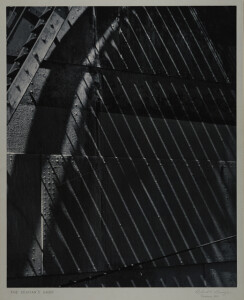 | 4/15/1949 | print was exhibited at the Annual Exhibition of Marine Photography, 1950 | Close-up view of shadow and lighting cast upon a vessel's side, resembling the strings of a harp. | P0025/03-#26 | |||||
| 2 | 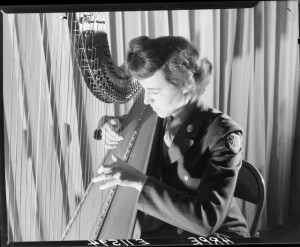 | 1/5/1945 | United States. Army. Women's Army Corps–Portraits. | Portrait of harpist, WAC Pvt. Eloise M. Bieber, A317112, home, Hummelstown, Penna., member of the HRPE Port Band. Photo was made at the Casino Club U.S.O. for recruiting purposes. Photo taken at HRPE, Newport News, Va. | Harp–Virginia–Newport News. | A portrait of a woman in front of her harp. | P0003/01-#E-11594 | |||
| 3 | 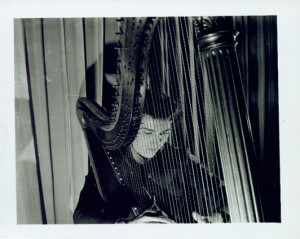 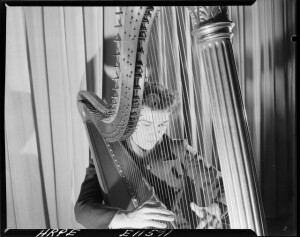 | 1/5/1945 | United States. Army. Women's Army Corps–Portraits. | Portrait of harpist, WAC Pvt. Eloise M. Bieber, A317112, home, Hummelstown, Penna., member of the HRPE Port Band. Photo was made at the Casino Club U.S.O. for recruiting purposes. Photo taken at HRPE, Newport News, Va. | Harp–Virginia–Newport News. | A portrait of a woman as seen through the strings of her harp. | P0003/01-#E-11591 | |||
| 4 | 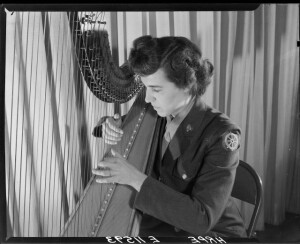 | 1/5/1945 | United States. Army. Women's Army Corps–Portraits. | Portrait of harpist, WAC Pvt. Eloise M. Bieber, A317112, home, Hummelstown, Penna., member of the HRPE Port Band. Photo was made at the Casino Club U.S.O. for recruiting purposes. Photo taken at HRPE, Newport News, Va. | Harp–Virginia–Newport News. | A portrait of a woman in front of her harp. | P0003/01-#E-11593 | |||
| 5 | 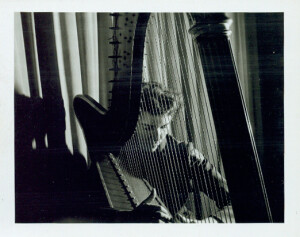 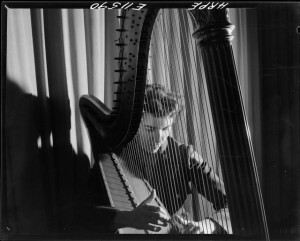 | 1/5/1945 | United States. Army. Women's Army Corps–Portraits. | Portrait of harpist, WAC Pvt. Eloise M. Bieber, A317112, home, Hummelstown, Penna., member of the HRPE Port Band. Photo was made at the Casino Club U.S.O. for recruiting purposes. Photo taken at HRPE, Newport News, Va. | Harp–Virginia–Newport News. | A portrait of a woman as seen through the strings of her harp. | P0003/01-#E-11590 | |||
| 6 | 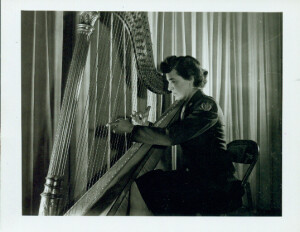 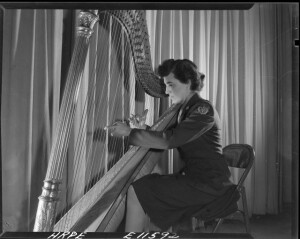 | 1/5/1945 | United States. Army. Women's Army Corps–Portraits. | Portrait of harpist, WAC Pvt. Eloise M. Bieber, A317112, home, Hummelstown, Penna., member of the HRPE Port Band. Photo was made at the Casino Club U.S.O. for recruiting purposes. Photo taken at HRPE, Newport News, Va. | Harp–Virginia–Newport News. | A portrait of a woman in front of her harp. | P0003/01-#E-11592 | |||
| 7 | 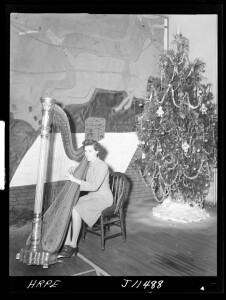 | 12/21/1944 | Port of Embarkation, Hampton Roads, Va. (U.S.). Kecoughtan Station Hospital. | Pvt. Eloise Bebber, A-317112 of Hummelstown, Pa., is shown playing the harp for the patients at the Kecoughtan Hospital, HRPE, Phoebus, Va., at a party given them by the American Red Cross. | Christmas decorations–Virginia–Hampton.; Christmas trees–Virginia–Hampton.; Harp–Virginia–Hampton. | Shows a WAC seated at a harp in front of a Christmas tree. | P0003/01-#J-11488 | |||
| 8 | 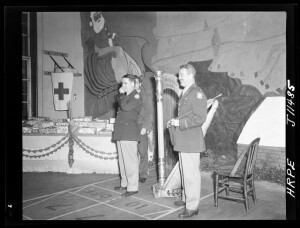 | 12/21/1944 | Port of Embarkation, Hampton Roads, Va. (U.S.). Kecoughtan Station Hospital.; United States. Army–Officers. | Major. Eben Breed, right, O-495162, of Garden City, New York, and Major M.J. Murphy, left, O-34551594 of Pitston, Penn., is shown on the platform during an address given to the patients of the hospital by Major Breed. The party was sponsored by the American Red Cross. Photo taken at Kecoughtan Hospital, HRPE, Newport News, Va. | Christmas decorations–Virginia–Hampton.; Harp–Virginia–Hampton.; Santa Claus–Virginia–Hampton. | Shows two officers standing next to a music harp, they are in front of a mural of Santa Claus. | P0003/01-#J-11485 | |||
| 9 | 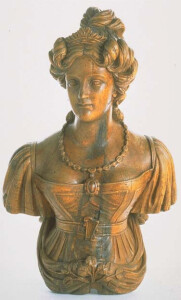 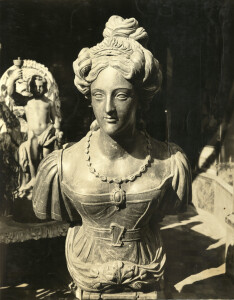 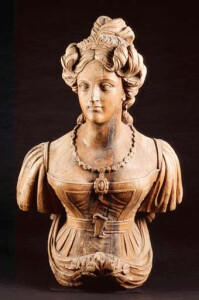 | SHORT DESCRIPTION: Half length female figure in early nineteenth century costume and wearing a small tiara with a small harp emblem at the waist. NOTES: [Carol Olsen, 1983] This figurehead has long been called "Irish Queen" because of the shamrocks at the base drapery and the harp at her waistband. However, she may not have anything to do with Ireland. Major sources in Ireland have mixed reactions to her which vary from "Those aren't shamrocks, and the harp could represent Wales", to "I think she personifies Ireland." Our evidence about her is too slight to identify her as Irish Queen in a label, but I refer to her that way for convenience. I wrote to various authorities in Ireland asking their opinions about the identify of this figurehead. Their responses ranged from 1) personification of Ireland, 2) possibly the pirate queen Grainne O'Malley, or 3) they have no idea. Cork Historical & Archaeological Society: Possibly Hibernia (Ireland) or Grainne O'Malley; Royal Society of Antiquaries of Ireland: Suggests date of 1810; suggests stylistic influence of the Royal Hibernian Academy sculptors, in particular Edward Smyth, suggests likely to represent Hibernia and think the quality is exceptionally fine for a ship figurehead; National Museum of Ireland: Perhaps Grainne O'Malley, think the shamrocks are only leaves (however they look like the shamrocks depicted in Webster's dictionary, the harp could represent Wales. Trinity College Library: No one could come up with an answer but it could be Grainne O'Malley or Queen Maeve. Irish National Maritime Museum: Bears no resemblance to any known historical figure, but could be fanciful representation of Grainne O'Malley or Queen Maeve of 3rd to 4th century BC. Art History Department, University College Dublin: Question the proposition that the figurehead represents an Irish figure. Seems idealized like an allegorical figure, eg, Erin, rather than representing a person. If she does represent a particular figure, perhaps she is Queen Maeve or Grainne. University College, Galway: Nicholas Canny, Professor of History and Dean of the Faculty of Arts: I think the carving is intended as a representation of Ireland who was traditionally protrayed as a female figure who had suffered under the tyranny of English rule. This was a literary motif in Gaelic poetry throughout the 18th century, but with the onset of Catholic Emancipation in the 19th century, Hibernia was more frequently displayed in more placid terms. National Gallery of Ireland: Idealized and could personify Ireland National College of Art and Design: Looks 1790s per Neoclassical style of dress. Probably personification of Hibernia or Ireland. Head with blank eyes, straight nose is conventionally Neoclassical, as is the stylize coronet. The shamrocks are not really shamrocks but stylized plants, unlike the more naturalistic shamrocks of the Romantic period (1830s on). The harp is the classical orchestral harp, not the figured harp with its romantic overtones. It reflects international Neoclassical tendencies more than any local reference. Edward Smyth was a skilled Irish sculptor of the Neoclassical period who is known to have worked in wood. Olsen's conclusions based upon correspondence and research: 1) two sources mention Edward Smyth's work. Since he worked in wood we should try to find examples of his work. 2) Even though many correspondents mention her Grainne was a rough and tumble pirate which our figurehead clearly doesn't depict. Our carving is comparable to figureheads of the 1840s such as Dona Januaria. I don't think our figurehead is Grainne O'Malley. 3) Two sources say the figureheads shamrocks are not really shamrocks. Also, the harp on our carving appears to be in an area of repair, and just possibly it is not original. This could mean our figurehead has nothing to do with Ireland or Wales. On the other hand, a number of people seem willing to suggest that she could represent Hibernia (Ireland). 4) Having checked all the sources, we can at least be sure that our figurehead is not a famous Irish woman immediately recognizable in learned Irish circles. 5) I estimate a date of circa 1840 based on 1) her similarity to the Dona Januaria figurehead and 2) her similar posture to the 1837 figurehead Mary Hay. 6) I believe it to be from a vessel of perhaps 600 tons 7) it was probably carved in Europe (although note that Dona Januaria is said to have been carved in Brazil). Tentative conclusions about this figurehead are that she: -dates from circa 1840, - I expect her to be from a vessel of perhaps 600 tons, - probably has been carved in Europe. | CL3698 | |||||||
| 10 | No image URL. | Ordered 8/29/03 BAMM | LB86946 | |||||||
| 11 | No image URL. | Catholic Church–Missions–History–19th century–Great Lakes Region (North America) | Great Lakes Region (North America)–History–19th century | Indians of North America–Missions–History–19th century–Great Lakes Region (North America); Ottawa Indians–Missions–History–19th century; Ojibwa Indians–Missions–History–19th century | Indian missions, immigrant migrations, and regional Catholic culture : __Slovene missionaries in the Upper Great Lakes, 1830-1892 __by Maureen Anna Harp | LB39670 | ||||
| 12 | No image URL. | NOTES: From "Coins, tokens and medals of the Dominion of Canada" by Alfred Sandham, page 43: Obverse- Female figure (Hibernia,) seated, to left and resting upon a harp, at bottom of which appears a single leaf of shamrock. " One Half Penny Token 1820." Reverse- Frigate under sail, to left. "TRADE AND NAVIGATION." Edge plain. LABEL COPY: Halfpenny Token Trade and Navigation 1820 QK 155 | CL3912 | |||||||
| 13 | 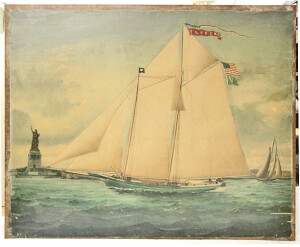 | NOTES: The Statue of Liberty in background at left. The schooner is flying a green flag with a yellow harp (flag of Ireland) and a small blue flag with a white diamond on the foremast. VESSEL INFORMATION - VESSEL NAME: FLORENCE VESSEL TYPE: TWO MASTED SCHOONER SERVICE DATES: 1871-1917 SHIPBUILDER: J. CARLL BUILDER LOCATION: NORTHPORT, L.I. SHIP OWNER: CAPTAIN SCOFIELD VESSEL DIMENSIONS: 41 X 26 X 9, 75 TONS VESSEL HISTORY: Operated out of New York. Foundered June 25, 1917 off Eatons Neck, Long Island Sound. | CL4580 | |||||||
| 14 | 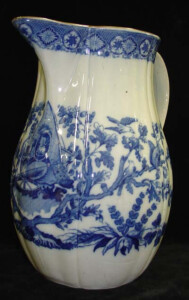 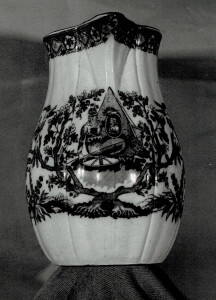 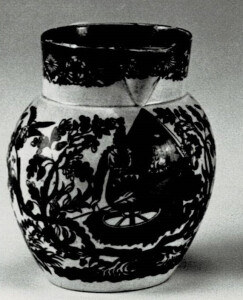 | SHORT DESCRIPTION: Pearlware, possibly Liverpool. Blue transfer printed jug with handle. The design leads one to believe that it was printed after the Battle of the Nile, (lst August 1798). Added to a fairly commonplace transfer usually seen on presentation bridal jugs, hence the motif which includes birds, their nests, squirrels, acorns and fruit and in this case has been added a pyramid and where the brides initials might be a portrait of Nelson and under it, L. Nelson. This is centered under the lip of the jug. Below Nelson's portrait is Britannia sitting on her shield. In one hand a spear and with the other hand, holding the medallion of Nelson. Pattern design inside and outside rim of the jug. A harp and reclining lion are present at the right. Probably produced to commemorate his death. | CL6859 | |||||||
| 15 | 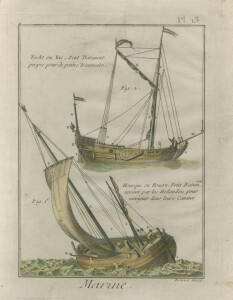 | SHORT DESCRIPTION: Engraving shows two small sailing vessels one of which was apparently invented in Holland specifically for navigating in canals. APPROXIMATE TRANSLATION: Fig 1: Small yacht for short trips. . Fig 2: “Small boat invented by the Dutch for navigating canals”. NOTE: Letters also label various parts of the vessels, but no identifying key is given. ADDITIONAL INFORMATION: Similar plates are contained within the "Encyclopédie; ou Dictionnaire raisonné des sciences, des arts et des métiers, par une société de gens de lettres. Mis en ordre & publié par m. Diderot ... & quant à la partie mathématique, par m. d'Alembert ..." By Denis Diderot (1713-1784) and Jean Le Rond d'Alembert (1717-1783) (TMM Call # AE25.D55 O Rare). The book of plates is titled: "Recueil de planches : sur les sciences, les arts libéraux, et les arts méchaniques, avec leur explication" Paris, chez Briasson rue Saint Jacques and Le Breton, premier Impremeur ordinaire du Roy, rue de la Harp, 1769.. (TMM Call# AE25.D55 Plates V6-7 CO) | CL10625 | |||||||
| 16 | 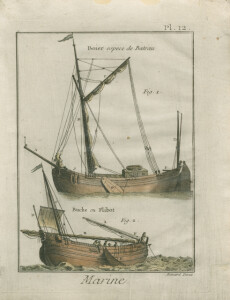 | APPROXIMATE TRANSLATION: "MARINE," (FIG 1) "Boier, sort of Boat" (FIG 2) "or Log Filbot" ADDITIONAL INFORMATION: Similar plates are contained within the "Encyclopédie; ou Dictionnaire raisonné des sciences, des arts et des métiers, par une société de gens de lettres. Mis en ordre & publié par m. Diderot ... & quant à la partie mathématique, par m. d'Alembert ..." By Denis Diderot (1713-1784) and Jean Le Rond d'Alembert (1717-1783) (TMM Call # AE25.D55 O Rare). The book of plates is titled: "Recueil de planches : sur les sciences, les arts libéraux, et les arts méchaniques, avec leur explication" Paris, chez Briasson rue Saint Jacques and Le Breton, premier Impremeur ordinaire du Roy, rue de la Harp, 1769.. (TMM Call# AE25.D55 Plates V6-7 CO) | CL10624 | |||||||
| 17 |  | 1863-1864 | "The way mails are sorted for our Squadron" "Here Sambo! put all these pictorials in my room, I'll have a jolly time reading 'em" "Heres lots o' letters, I wonder whose a going to look out for em, I aint!" "Frank Leslie's" "Harp-" | "The way mails are sorted for our Squadron" | MS0007/-01.07#01 | |||||
| 18 | No image URL. | HARPOON POINT | CL25123 | |||||||
| 19 | 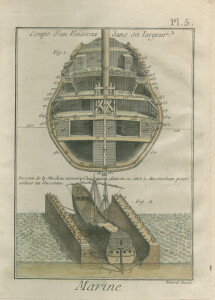 | titleSHORT DESCRIPTION: Hand colored engraving showing a cross section of a large vessel and a dry dock used to raise ships. Both figures are numbered indicating that there should be a key. APPROXIMATE TRANSLATION: (title) “Naval Ship: Cutaway of a Vessel by width”; Fig 2: “drawing of the machine called the Chamean that is used in Amsterdam for putting together/taking apart a ship” gives a bird’s eyes view of the ship’s length." ADDITIONAL INFORMATION: Similar plates are contained within the "Encyclopédie; ou Dictionnaire raisonné des sciences, des arts et des métiers, par une société de gens de lettres. Mis en ordre & publié par m. Diderot ... & quant à la partie mathématique, par m. d'Alembert ..." By Denis Diderot (1713-1784) and Jean Le Rond d'Alembert (1717-1783) (TMM Call # AE25.D55 O Rare). The book of plates is titled: "Recueil de planches : sur les sciences, les arts libéraux, et les arts méchaniques, avec leur explication" Paris, chez Briasson rue Saint Jacques and Le Breton, premier Impremeur ordinaire du Roy, rue de la Harp, 1769.. (TMM Call# AE25.D55 Plates V6-7 CO) | CL10628 | |||||||
| 20 | 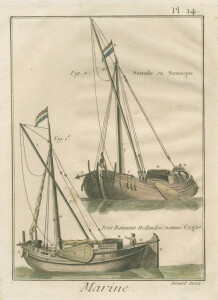 | APPROXIMATE TRANSLATION: “Small Dutch boat named Cague” " A smack or fishing sloop " NOTE: Various parts of each ship are identified by letter. ADDITIONAL INFORMATION: Similar plates are contained within the "Encyclopédie; ou Dictionnaire raisonné des sciences, des arts et des métiers, par une société de gens de lettres. Mis en ordre & publié par m. Diderot ... & quant à la partie mathématique, par m. d'Alembert ..." By Denis Diderot (1713-1784) and Jean Le Rond d'Alembert (1717-1783) (TMM Call # AE25.D55 O Rare). The book of plates is titled: "Recueil de planches : sur les sciences, les arts libéraux, et les arts méchaniques, avec leur explication" Paris, chez Briasson rue Saint Jacques and Le Breton, premier Impremeur ordinaire du Roy, rue de la Harp, 1769.. (TMM Call# AE25.D55 Plates V6-7 CO) | CL10626 | |||||||
| 21 | 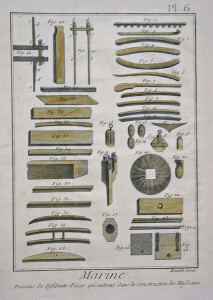 | SHORT DESCRIPTION: Hand colored engraving depicting the different pieces used to construct a ship. Illustrated are blocks, pulleys, gun ports, bitts, round top and other assorted timbers. ADDITIONAL INFORMATION: Similar plates are contained within the "Encyclopédie; ou Dictionnaire raisonné des sciences, des arts et des métiers, par une société de gens de lettres. Mis en ordre & publié par m. Diderot ... & quant à la partie mathématique, par m. d'Alembert ..." By Denis Diderot (1713-1784) and Jean Le Rond d'Alembert (1717-1783) (TMM Call # AE25.D55 O Rare). The book of plates is titled: "Recueil de planches : sur les sciences, les arts libéraux, et les arts méchaniques, avec leur explication" Paris, chez Briasson rue Saint Jacques and Le Breton, premier Impremeur ordinaire du Roy, rue de la Harp, 1769.. (TMM Call# AE25.D55 Plates V6-7 CO) | CL10819 | |||||||
| 22 | No image URL. | HARPOON POINT | CL25124 | |||||||
| 23 | 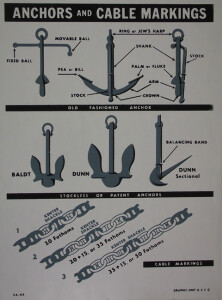 | NOTES: With diagram showing the parts of an anchor and chain. DUPLICATE NOTES: One (1) duplicate. | CL13893 | |||||||
| 24 | No image URL. | 1st edition; one of 11 large paper copies. | LB31405 | |||||||
| 25 | 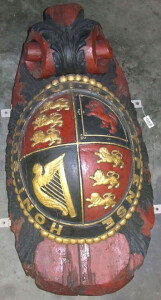 | NOTES: This ornament represents the royal arms of Queen Victoria. The carving is divided into four segments. The first segment represents England (three lions passant guardant), the second represents Scotland (lion rampant), the third segment represents Ireland (harp with angel head and wings), and the fourth England (three lions passant guardant). David Pulvertaft 12/8/2010 states about this piece: One of your predecessors at the Mariner's Museum sent me copies of the record sheet in September 1995. At that time the carving from HMS Raleigh was classified as a "Stern Board" (as is mentioned in your modern assessment). I suspect this may have been correct as the 1873 ship had two proper figureheads during her life, one fitted on building, the other when she was fitted out as a flagship in 1885, each in the likeness of Sir Walter Raleigh. NOTES: From [http://www.randomhouse.com/wotd/index.pperl?date=19960827] Honi soit qui mal y pense is the motto of the Order of the Garter. It's French for 'shamed be the person who thinks evil of it'. Supposedly, in the fourteenth century, Edward III was dancing with the Countess of Salisbury, and her garter fell off. In response to the snickers of those watching, Edward said "Honi soit qui mal y pense," and tied the garter around his own leg. The phrase then became the motto of the order, which Edward founded. The Most Noble Order of the Garter is the oldest and most important of the orders of knighthood in Great Britain. Its head is the sovereign, and the garter (inscribed with the motto) thus appears on the royal arms of Great Britain. As a result, the phrase is sometimes erroneously described as "the motto of Great Britain" or something similar. VESSEL INFORMATION-- VESSEL NAME: H.M.S. RALEIGH VESSEL TYPE: Steam Frigate; Powersail SERVICE DATES: 1873-1905 | CL3734 | |||||||
| 26 | 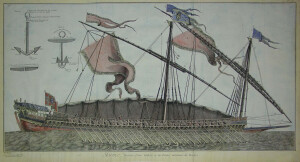 | ROUGH TRANSLATION: “Ship, drawing of a galley called the Reale” “From the drawings of Monsieur Belin, naval engineer” SHORT DESCRIPTION: Large hand-colored engraving of an ancient multi-oared warship (apparently depicting the Royal Barge of Louis XIV). There are five men and each set of 26 oars. The men appear to be naked. There are three men standing over the rowers, each brandishing what looks like a whip or long stick. The area holding the rowers is covered with a tent-like structure (la tante). There are a number of large banner and flags flying on the vessel. All are highly decorative and several with fleur-de-lis and crowns. The parts of the vessel are lettered and number, but there is no key present. The top left corner shows two anchors (ancre) with all of the parts identified. ADDITIONAL INFORMATION: Similar plates are contained within the "Encyclopédie; ou Dictionnaire raisonné des sciences, des arts et des métiers, par une société de gens de lettres. Mis en ordre & publié par m. Diderot ... & quant à la partie mathématique, par m. d'Alembert ..." By Denis Diderot (1713-1784) and Jean Le Rond d'Alembert (1717-1783) (TMM Call # AE25.D55 O Rare). The book of plates is titled: "Recueil de planches : sur les sciences, les arts libéraux, et les arts méchaniques, avec leur explication" Paris, chez Briasson rue Saint Jacques and Le Breton, premier Impremeur ordinaire du Roy, rue de la Harp, 1769.. (TMM Call# AE25.D55 Plates V6-7 CO) | CL11036 | |||||||
| 27 | 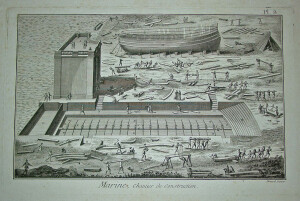 | SHORT DESCRIPTION: Black and white engraving depicting a shipyard. In the foreground appears to be a structure resembling a drydock. There is a large ship, possibly a merchant ship, under construction in the background. There are may men working in the yard, hewing timbers with axes, working with frame saws, hauling timbers and frames, and looking at plans. There are two men sitting on a timber at the bottom right one of which is holding what looks like a square canvas or paper (possibly an artist?) while another man sits on a timber smoking a long stemmed pipe. There is a large stone structure next to the drydock. There are many letters and numbers on the engraving indicating that a key may originally have been present. ADDITIONAL INFORMATION: Similar plates are contained within the "Encyclopédie; ou Dictionnaire raisonné des sciences, des arts et des métiers, par une société de gens de lettres. Mis en ordre & publié par m. Diderot ... & quant à la partie mathématique, par m. d'Alembert ..." By Denis Diderot (1713-1784) and Jean Le Rond d'Alembert (1717-1783) (TMM Call # AE25.D55 O Rare). The book of plates is titled: "Recueil de planches : sur les sciences, les arts libéraux, et les arts méchaniques, avec leur explication" Paris, chez Briasson rue Saint Jacques and Le Breton, premier Impremeur ordinaire du Roy, rue de la Harp, 1769.. (TMM Call# AE25.D55 Plates V6-7 CO) | CL16630 | |||||||
| 28 | 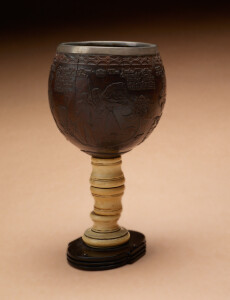 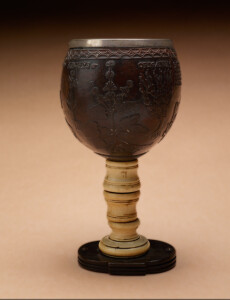 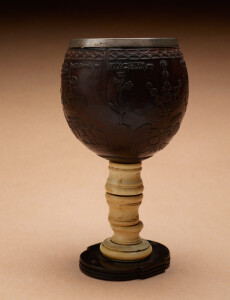 | SHORT DESCRIPTION: Goblet made of a coconut depicts the Battle of Saintes. Goblet is made of a coconut shell and has a sterling silver rim. The stem of the goblet is made up of three spindles of ivory, the top two appear to be hippo ivory (concentric ovals in the ivory are unique to this animal) and the lowest spindle is elephant ivory- as indicated by the cross hatched diamond pattern. The base is made of a dark wood. The coconut shell is covered with carvings of five ships identified as "C De Grass in Ville De Paris struck to Sir Saml. HOOD 12th apl 82," "Prince Wm. in Chace of an other SHIP," "Ardent Struck to the Pr. Wm.", three plants identified as "STACHYS" "ORIGANUM' "ORCHI_", and two figures, one male and the other female. The female appears to be St. Catherine (as indicated by her symbol, the Catherine Wheel at her feet). However, it is more likely Britannia, considering the subject matter. Around the woman's neck hangs a mask. The goblet bears the inscriptions: "Britain For Freedom Firmly Joind, Unite Your Councels and Your Forces Combine, The Rose, Thistle, Crown & Harp, Nobly Defend be their Champion & faithful friend." NOTES: [John A. Tilley, November 12, 1981] The Battle of the Saintes was one of the major events of the War of American Independence. The goblet, while its provenance is unknown, almost certainly was made in England or one of the West Indian islands shortly after the event as a souvenir. NOTES: The Battle of the Saintes was the last major naval action between the French and English in the American Revolutionary War. It was fought between April 9 and 12th 1782 near the Iles des Saintes as small group of islets just north of Dominica in the West Indies. Admiral Sir George Rodney's victory over the French fleet of the Comte de Grasse foiled the latter's attempt to invade Jamaica and enabled Britain to secure its position in the West Indies even though she lost her American colonies. The battle is famous as the point of origin of the tactic of 'breaking the line', which was achieved with great, albeit accidental, effect by Rodney in seizing an advantage created by a shift of wind as the fleets began the action. See the attached file for a description of the April 9-12, 1782 battle by Alfred Thayer Mahan. | CL12406 | |||||||
| 29 | 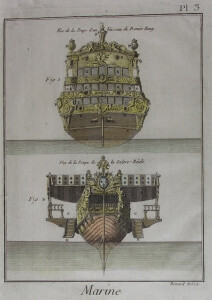 | SHORT DESCRIPTION: Hand colored engraving showing the sterns of a First Rate ship and a Royal galley. NOTES: Similar plates are contained within the "Encyclopédie; ou Dictionnaire raisonné des sciences, des arts et des métiers, par une société de gens de lettres. Mis en ordre & publié par m. Diderot ... & quant à la partie mathématique, par m. d'Alembert ..." By Denis Diderot (1713-1784) and Jean Le Rond d'Alembert (1717-1783) (TMM Call # AE25.D55 O Rare). The book of plates is titled: "Recueil de planches : sur les sciences, les arts libéraux, et les arts méchaniques, avec leur explication" Paris, chez Briasson rue Saint Jacques and Le Breton, premier Impremeur ordinaire du Roy, rue de la Harp, 1769.. (TMM Call# AE25.D55 Plates V6-7 CO) NOTES: The engraving appeared in Denis Diderot's monumental Encyclopedie. The engraving is based on an earlier depiction by Jacques-Nicholas Bellin, the primary cartographer for the French Navy. Jacques-Nicolas Bellin (1703-1772) was among the most important mapmakers of the eighteenth century. In 1721, at only the age of 18, he was appointed Hydrographer to the French Navy. In August 1741, he became the first Ingénieur de la Marine of the Dépôt des cartes et plans de la Marine (the French Hydrographic Office) and was named Official Hydrographer of the French King. During his term as Official Hydrographer, the Dépôt was the one of the most active centers for the production of sea charts and maps in Europe. Their output included a folio-format sea atlas of France, the Neptune Francois. He also produced a number of sea atlases of the world, including the Atlas Maritime and the Hydrographie Francaise. These gained fame and distinction all over Europe and were republished throughout the eighteenth and even in the nineteenth century. Bellin also produced smaller format maps such as the 1764 Petit Atlas Maritime, containing 580 finely-detailed charts. He also contributed a number of maps for the 15-volume Histoire Generale des Voyages of Antoine François Prévost. Bellin set a very high standard of workmanship and accuracy, cementing France's leading role in European cartography and geography during this period. Many of his maps were copied by other mapmakers across the continent. TRANSLATION: (Provided French) (Abbreviation PL.3 appears at the top… Probably for Plate 3) Vue de la Poupe d’un Vaisseau du Premier Rang, Fig. 1, Vue de la Poupe de la Galere-Réale Fig. 2, Marine (English Translation) Plate 3, View of the Stern/Poop Deck on the First Rank Ship, Figure One, View of the Stern/Poop Deck of the Galere-Réale, Figure 2, Marine/Navy | CL10629 | |||||||
| 30 | 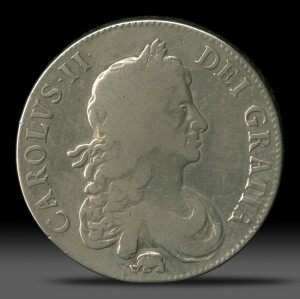 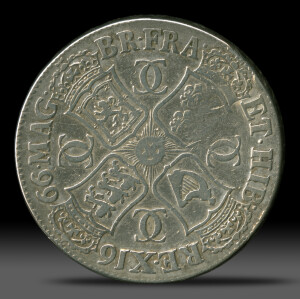 | SHORT DESCRIPTION: Coin with a raised image of a draped laureate bust Charles II facing right. Under this is the small image of an elephant, the symbol of the Royal African Company, with tusks facing left. The inscription runs from left to right around the edge of the coin. On the reverse there are four crowned cruciform shields bearing the arms of England (three stacked horizontal rampant lions), Scotland (single standing rampant lion), France (three fleur de lis), and Ireland (harp). The shields are separated by interlocking C's. In the center is a circle with a cross in it surrounded by small rays. NOTES: [Martha R. Wyatt] Produced the year of the great fire in London, this crown bares a portrait of Charles II on the front with an elephant the symbol of the Royal African Company. Gold and slaves were the company's main business; shareholders included the Duke of York, several Lord Mayors of London, and the philosopher John Locke. As a special mark of recognition to the company the coins made of African gold were marked with the company's symbol, either an elephant or an elephant with a castellated howdah. The badge is also found on some silver coins. [From Spinks catalog, May 2005, The Samuel King Collection of Highly Important Coins] In 1663 Charles II sold the control of African trade to The Company of Royal Adventurers of England Trading in Africa. The Company failed later in that decade but re-emerged under the guise of the Royal African Company in 1672. Supported by substantial investment from the king himself, the Company was primarily concerned with the trade of slaves and gold dust from the Ashanti people of what was then known as Guinea, located on the West African coast. The provenance marks of the elephant and the elephant and castle (found on the Royal African Company coat of arms) located below the monarch’s bust denote that the bullion for the coin was supplied to the Mint by these African trading operations. NOTES: "Guinea" was not an official name for the coin, but much of the gold used to produce the early coins came from Guinea (a republic in eastern Africa on the Atlantic) the Africa company having a charter which allowed them to put their symbol, an elephant beneath the king's effigy on the coins, and the term "guinea" originated from this. The coin was produced each year between 1663 and 1684, with the elephant appearing on some coins each year from 1663–1665 and 1668, and the elephant and castle on some coins from 1674 onwards. The obverse and reverse of this coin were designed by John Roettier (1631– circa 1700). The obverse showed a fine right-facing bust of the king wearing a laurel wreath (amended several times during the reign), surrounded by the legend CAROLVS II DEI GRATIA, while the reverse showed four crowned cruciform shields bearing the arms of England, Scotland, France, and Ireland, between which were four sceptres, and in the centre were four interlinked "C"s, surrounded by the inscription MAG BR FRA ET HIB REX date. To avoid confusion with gilded silver coins the edge was milled to deter clipping or filing (and to distinguish it from the silver half-crown which had edge lettering). Until 1669 the milling was perpendicular to the coin, giving vertical grooves, while from 1670 the milling was diagonal to the coin. | CL28548 | |||||||
| 31 | 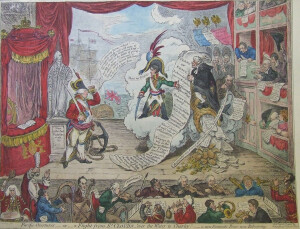 | SHORT DESCRIPTION: [Pulled from identical image at The British Museum] The stage, flanked by the stage-boxes, extends across the design, the base of which is the orchestra, where the new Ministry perform. George III has stepped on to the stage from the royal box (left) and confronts Napoleon, who stands arrogantly upon clouds and points to an enormous scroll held up by Talleyrand. This stretches across the cloud to rest on the stage. The Emperor, in uniform, with spurred jackboots and wearing a large, feathered bicorne, holds a sword in his right. hand and says fiercely: "There's my Term's." The King, who wears uniform with a small cocked hat and buckled shoes, holds his sword against his shoulder. He inspects the scroll through his glass, saying: " - Very amusing Terms indeed! - and might do vastly well with some of the new-made little Gingerbread kings - but WE are not in the habits of giving up either "Ships, or Commerce, or Colonies", merely because little Boney is in a pet to have them!!!" The scroll is inscribed: 'TERMS OF PEACE - Acknowledge me as Emperor - "mantle your Fleet, - Reduce your Army - Abandon Malta & Gibraltar, - Renounce all Continental Connection - Your Colonies I will take at a Valuation, - Engage to pay to the Great-Nation for 7 Years annually £1.000.000. and Pace in my Hands as Hostages the Princess Charlotte of Wales, with Ten of ye late Administration whom I shall name.' Talleyrand kneels on one knee, displaying a deformed left leg, on a cornupia which rests on the clouds that support Napoleon. He wears a long gown with a rosary (denoting the ex-Bishop of Autun); a pen is behind his ear. From the cornucopia papers, money-bags, and coin pour down on to the stage. The papers are: 'Address to the Papists'; 'Loan to the - ['Prince' implied]; 'To the United Irishmen'; 'To the London Corresponding Society'; 'The Press'; 'The Argus'; 'For the Whig Club'; 'To the Army; 'To the Navy', 'To [the] Volunteers'. Money-bags are labelled: 'Maynooth [word illegible]', 'Horne Tooke', 'Morning Chronicle', '[Cobbett's] Weekly Register', 'Thelwall.' Immediately behind Talleyrand, and also on the Napoleonic clouds crouch Arthur O'Connor, looking down conspiratorially at Fox in the orchestra below. His words extend in a long label towards Fox: "Remember m Friend your Oath, - " Our Politicks are the same!"" He holds a paper: 'at Maidstone Not Guilty - N.B - my Confederate Quigley only, was Hanged there.' Behind Talleyrand and O'Connor three desiccated corpses wearing French Grenadier's uniform hold up three eagles to each of which a banner is attached: 'Army of England', 'Army of Ireland', 'Army of Scotland'. Their caps are decorated with an 'N' surmounted by a crown. Behind them bayonets recede in perspective, their holders hidden by the peace scroll. Most of the orchestra sit facing each other at a long desk whose slopes hold their music. At its head (left) sits Grenville, the First Violin, saying "Attention!"; in his pocket is a paper: 'Broad Bottom Concert'; his music is 'Britons Strike Home'. Facing him at the opposite end sits Moira, very erect, blowing a trumpet; his music is 'See the Conquering Hero comes'. Four performers sit on each side; nearest the stage and on Grenville's left, sit (left to right) Fox, with a violin, pausing with extended bow to look up at O'Connor; his music is 'God save the King'. Next him is Lord Spencer, playing a violin, but without music Windham, also playing a violin, his music is 'Cheese Parings'. Next, and on Moira's right, Sheridan, fat and bloated, sleeps with folded arms, clasping a bassoon; his music is 'The Midwatch' [for Sheridan as the sleeping watchman]. The others, facing the stage, turn their heads in profile. Little Lord Henry Petty, on Grenville's right, wearing his Chancellor's gown, plays the triangle; his music is 'the little Jesuits Jig' [he is the son of 'Malagrida'; for 'jig']. Next Sidmouth performs on a clyster-pipe; his music is 'Water-Gruel' . Lauderdale blows the French horn, his music is 'Brissots Delight'. Tierney, self-absorbed, plays two pipes: one inscribed 'Grenville' the other 'Fox'; his music is 'How Happy could I be with either', with another paper headed 'Borough' [he was M.P. for Southwark, and regarded as eager for office under any Government]. The rest of the orchestra are on the left, behind Grenville's back. On the extreme left. Erskine, the egotist, full face, regardless of the others, beats a drum with the mace. Lord Ellenborough stands as if conducting, holding up a rolled document: 'Bill of Indemnity' [the Bill for giving indemnity to witnesses against Melville, it was opposed by Ellenborough,'Parl. Hist.' vi. 248 f.]. Bedford plays the harp: 'Harp of St Patrick'. In his pocket is 'a Serious Ballad Burke to Duke' [Burke's 'Letter to a Noble Lord' was to his brother]. Grey, his music 'Rule Britannia', hanging over the back of Grenville's chair, plays the 'cello. The royal box is sumptuously draped, and surmounted with a crown and crossed sceptres, with the inscription: 'Ge IIId | whom God long preserve'. Behind his empty chair is the pompously projecting stomach with Garter ribbon, and hand holding the wand of the Lord Chamberlain, Lord Dartmouth. On the front of the box lies an open book: 'Shakespeare - I know You all.' Next the box and immediately behind the King is a lifelike statue of Pitt, wearing (like Petty) the gown of the Chancellor of the Exchequer. One hand rests on a pillar inscribed 'Integrity'. The high pedestal is inscribed 'Non sibi sed Patriae vixit' [the motto on the badges of the Pitt Clubs which came into existence on Pitt's death. Broadley, i. 242]. Beside the King is an anchor and rope. At the back of the stage, behind the King, is the sea with a man-of-war in full sail: 'The Royal Sovereign'. On the r. are four stage-boxes. On the level of the stage the Prince and Mrs. Fitzherbert sit gazing at each other; he holds his cocked hat, she has a fan with the Prince's feathers and holds a playbill: 'Shortly will be Perform'd the Farce Dolly made a Dutchess.' In the box immediately above are Horne Tooke (in clerical dress) and his friend Burdett, holding up his cocked hat. Both applaud vigorously, saying respectively 'Bravissimo!' and 'Bravo'; they look towards Talleyrand and Napoleon. The former's playbill is 'Duet on a Pair of Portraits', the latter's 'The Brentford Bully, a new Song - Liberty and Equality down with all the Prisons'. Over this box are the Prince's feathers. Next it, and above the door leading to the stage, is a small box from which Grattan leans delightedly, his playbill is 'Irish-Jig - Report of the secret Committee - Neilson told me he had Sworn Mr Grattan.' Above Grattan, in a small box at the upper edge of the design, are the Duke of Clarence and Mrs. Jordan, both grossly caricatured. Their playbill is 'Jobson & Nell' [the cobbler and his wife in 'The Devil to Pay']. 5 April 1806 Curator's comments: (Description and comment from M.Dorothy George, 'Catalogue of Political and Personal Satires in the British Museum', VIII, 1947) The Ministry's peace overtures (which began in March, and continued after Fox's death on 13 Sept.) are associated with Jacobinism, sedition, and treason, and especially with Franco-Irish intrigue and the relations between Fox and O'Connor. Fox's evidence at Maidstone (May 1798) was: 'I always thought Mr O'Connor . . . attached to the principles and the constitution of this country, upon which the present family sit upon the throne, and to which we owe all our liberties'. O'Connor (whom Fox met in France) at this time was a general in the French service. For 'The Press', organ of the United Irishmen; for 'The Argus', a propagandist paper in English, printed in Paris, see BMSat 9998. Napoleon is charged with financing English and Irish Jacobins, and even the anti-Pittite Press, i.e. the 'Morning Chronicle' and 'Cobbett's Political Register', though Cobbett had maintained the dangers of a popular demand for peace, and recently asserted that a tolerable peace was unattainable 'until we have a real army'. 'Pol. Reg.', 8 Feb. (ix. 167). The allusion to Maynooth is obscure, and is probably due to Gillray's hatred of 'Popery'. The seminary was founded in 1795 by an Act of the Irish Parliament: the first move towards an additional grant was a suggestion by Petty to Grenville, 25 Apr. 1806 ('H.M.C., Dropmore MSS.' viii. 120 f.), not carried out till after Fox's death. The divisions in the new Ministry, &c, are suggested by each man's absorption in a separate tune. There is a second state, the Prince of Wales altered to Lord Derby, it is said on account of the offence given to the King by the Prince's association with Mrs. Fitzherbert. The play-bill is altered to: 'the Farce Darby a Duke & Joan a Duchess'. This state was reprinted in 1830 and 1851. Grego, 'Gillray', p. 330 f. (reproduction). Wright and Evans, No. 314. Reprinted, 'G.W.G.', 1830. Broadley, i. 241 f. Reproduced, Grand-Carteret, 'Napoléon', No. 163. | CL16343 | |||||||
| 32 | 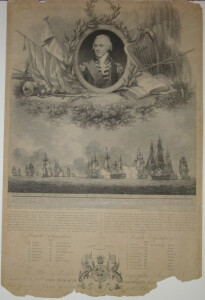 | SHORT DESCRIPTION: Engraving containing a bust-length portrait of Sir John Borlase Warren, slightly turned towards the left and dressed in a naval uniform with the riband of the Bath and epaulettes, all inside an oval. The portrait is surrounded by oak and laurel leaves, and images of weaponry, an anchor, banners, an Irish harp, a willow tree, and a cartouche with Warren's title and a key above his portrait. Underneath the portrait are a vignette of a sea battle off Ireland and the Admiral's arms. NOTES: Admiral Sir John Borlase Warren, Bart. K.B. and the Victory off Ireland. The french squardron, commanded by M. Bompard, were discovered at noon on the 11th of October, 1798, but could not be brought to action until 20 minutes past 7, the following morning at about 6 Leagues distance from Tory Island. At 11 o'clock the HOCHE, after a gallant defense, struck, when the frigates made sail to escape; but being immediately pursued, in five hours afterwards, L'EMBUSCADE, LA COQUILLE, and LA BELLLONE, also lowered their colours. The chase of the remaining five ships was continued, but with night coming on they were lost sight of. On the morning of the 13th, the MALAMPUS, however, discovered LA RESOLUE and L'IMMORTALITE, the former of which was soon struck without returning a single gun, her consort L'IMMORTALITE, having given her no assistance. The MERMAID of 32 guns, Capt. Newman, afterwards fell in with the LA LOIRE, whom she engaged and crippled, but was herself so disdabled as to be unable to pursue the contest, but on the 18th the ANSON of 44, Capt. Durham, fell in with, and took LA LOIRE, off Cape clear; and L'IMMORTALITE was taken on the 20th, by the FISHGUARD (FIGARD) of 38 Guns, Capt. Martin, on her return to Brest; thus, LA ROMAINE and LA SEMILLANTE only escaped. The whole of the Frigates excepting LA RESOLUE, as well as the HOCHE, were obstinately defended, all of them being heavy ships; and as well as the Ship of the Line, necessary for the establishment of their views and plans, in their thus frustrated intention of invading Ireland. | CL11012 | |||||||
| 33 | No image URL. | Sailors–Religious life–Great Britain; Conversion.; Christian life.; Christian literature. | Each religious dialogue has a separate t.p. with caption titles. Imprint varies on additional dialogues. | LB34692 | ||||||
| 34 | 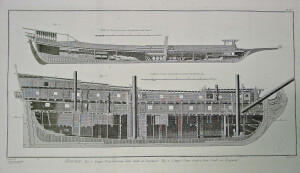 | SHORT DESCRIPTION: Black and White copper engraving by Benard after Goussier, from drawings by Mr. Belin. From the marine section of Encyclopedie of Diderot and D'Alembert, Paris, 1751-70. The top cutaway shows a commercial vessel with goods stowed in holds. On the bottom is the galley. NOTES: [Martha R. Wyatt - December 20, 2001] This engraving is from the Marine section of Denis Diderot's, L'Encyclopedie, ou Dictionnaire Raissonne des Sciences, des Arts et des Metiers. The Encyclopedia contains 2,569 plates, grouped by theme, in 11 volumes. The original folio edition includes a mix of single-page and double, triple and quadruple page images. Legends precede each group of plates. Individual plates frequently contain multiple figures, usually in combination with reference numbers or characters that coordinate with the text of the legends. Although, the Encyclopedia was conceived to be a reference work, the first volume, which concerned the arts and sciences, appeared in 1762, eleven years after the publication of the first volume of the text. In addition, the original estimate of 600 plates soon proved to be insufficient. These factors made coordination of the text and the plates difficult. In some cases, the authors were able to consult the completed images while writing their articles and to give precise references to the pertinent plate and figure numbers. In other cases, the plates were drawn long after the completion of the articles, and sometimes there is very little correlation between the two. The impact of the Encyclopedia was enormous, not only in its original edition, but also in multiple reprinting in smaller formats and later adaptations. It was hailed, and also persecuted, as the sum of modern knowledge, as the monument to the progress of reason in the 18th century. Diderot had two main collaborators, the mathmatician Jean e Rond d'Alembert and Louis de Jaucourt. Many others contributed to the work including, George Louis Buffon on nature, Baron de Montesquieu on politics and Jean-Jacques Rousseau and Voltair on philosophy. The engraver Robert Benard was active in Paris circa 1734, He worked for libraries and Diderot's Encyclopedia. NOTES: Similar plates are contained within the "Encyclopédie; ou Dictionnaire raisonné des sciences, des arts et des métiers, par une société de gens de lettres. Mis en ordre & publié par m. Diderot ... & quant à la partie mathématique, par m. d'Alembert ..." By Denis Diderot (1713-1784) and Jean Le Rond d'Alembert (1717-1783) (TMM Call # AE25.D55 O Rare). The book of plates is titled: "Recueil de planches : sur les sciences, les arts libéraux, et les arts méchaniques, avec leur explication" Paris, chez Briasson rue Saint Jacques and Le Breton, premier Impremeur ordinaire du Roy, rue de la Harp, 1769.. (TMM Call# AE25.D55 Plates V6-7 CO) | CL28529 | |||||||
| 35 | No image URL. | NOTES: Bottle found on the Atlantic beach 10 miles south of St. Augustine, Florida, at the high tide mark, on May 8, 1960. The bottle had been set adrift in mid-Atlantic with enclosures as an advertising stunt. Objects inside bottle included an Ovaltine flyer, a Guinness flyer explaining how to turn bottle into a lamp with a souvenir bottle label, a flyer on stationary marked FROM THE OFFICE OF: KING NEPTUNE, and a booklet describing "The 'whys' and 'wherefores' of Guinness Stout". In 1959 Guinness Brewery launched 150,000 bottles into the Atlantic Ocean and Caribbean Sea in a promotional campaign. INVENTORY: bottle label, Ovaltine flyer, Guinness flyer, bottle cap, Guinness brochure- there are five (5) component parts. | CL13493 | |||||||
| 36 | 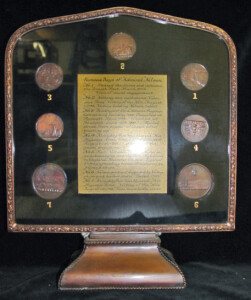 | SHORT DESCRIPTION: Framed, free standing collection of seven commemorative medallions related to the career of Vice-admiral Lord Horatio Nelson. Copper colored frame with glass on both sides, on the interior are seven medallions and a small gold colored paper panel with text describing the medallions. The base has rope decoration along the edges with the frames edge is cast with laurel. [No. 1] Bronze medallion commemorating the Battle of Copenhagen, 1801. The obverse features Justice, sword in right hand, holding up the scales. Near by a compass on stand, against which lean two medallions with busts of 'H. PARKER.' and 'L. NELSON.' Sea horizon with ship. Anchor and book in foreground. With the legend 'MARITIME JUSTICE AND BRITISH VALOR.' The reverse depicts a view of the battle, Copenhagen, the Sound and Forts at Narrows. Exergue: 'PASSED . THE . SOUND . AND DEFEATED . Y . DANISH FLEET . MAR . 30 .' [No. 2] Bronze medallion by Thomas Wyon senior to celebrate Nelson's Victory of the Nile, 1798. The obverse depicts a shield and fouled anchor on which is written 'NOV . 29 LAUS DEO 1798'. "Laus Deo translates 'Praise to God'. An eye above with sun rays. With the legend 'SUB HOC SIGNO VINCES' which translates "Under this sign thou shalt conquer". The reverse depicts a winged female, recumbent at foot of pyramid, holds in left hand a medallion with Nelson's bust, inscribed 'A . LD . NELSON.' In her right hand a cross, near which a skull on ground. Behind, a lion, harp and palm tree.. With the legend 'VIRTUTE NIHIL OBSTAT & ARMIS' which translates "Nothing withstands valour and arms". In Exergue 'VICTORY OF THE NILE, AUGt. 1. 1798". The medallion is marked WYON on both the obverse and reverse. The date on the reverse is that of a thankgiving service for the battle at St. Paul's Cathedral. [No. 3] Bronze medallion commemorating HMS 'Foudroyant'. The obverse depicts and head and shoulders bust of Vice-Admiral Horatio Nelson (1758-1805) facing three-quarters left, wearing cocked hat with diamond aigrette, and uniform with epaulettes. With the legend: 'HORATIO VISCOUNT NELSON'. Exergue: 'BORN, 29TH. SEPTEMBER, 1758 . DIED, 21ST. OCTOBER, 1805.' Along bottom edge: 'REGD. NO. 311490.' The reverse features a view of the 'Foudroyant' at anchor and scene from the port quarter. With the legend 'FOUDROYANT. LORD NELSON'S FLAGSHIP.' At the bottom is the text 'MEDAL STRUCK FROM COPPER OF VESSEL AFTER BREAKING UP.' Exergue: 'COMMENCED BUILDING, 1789. LAUNCHED AT PLYMOUTH, APRIL, 1798. WRECKED AT BLACKPOOL JUNE 16TH. . 1897.' [No. 4] Bronze medallion commemorating the Battle of the Nile, 1798. The obverse depicts the Admiral's bust, front view with his head facing three-quarter right. In full uniform with ribbon over right shoulder and star on chest, and one naval medal around his neck. With the legend 'ADMIRAL LORD NELSON OF THE NILE.' and 'BRITAINS GLORY & DEFENCE.' at the bottom. The reverse depicts the British flagship pushing between two ships at anchor and firing broadsides as she moves through the line. With the legend 'ALMIGHTY GOD HAS BLESSED HIS MAJESTY'S ARMS.' Exergue: 'FRENCH FLEET DEFEATED AUGUST . I . 1798.' The medallion is by Thomas Wyon Sr. [No. 5] Bronze medallion commemorating the return home of Admiral Lord Nelson in 1800 after the Battle of the Nile. The obverse features the Admiral's bust facing left with hair in queue. In full uniform with ribbon and star of Bath, and naval medal around his neck. With the legend 'ADMIRAL LORD NELSON.' On the reverse is a scene depicting Nelson's ship nearing the shore, on which Britannia holds out a wreath towards him, spear in her left hand. Near her an altar inscribed 'AUG . 1 1798.' An anchor and the union shield lean against it. With the legend: 'HAIL! VIRTUOUS HERO. THY VICTORIES WE ACKNOWLEDGE AND THY GOD.' Exergue: 'RETURND TO ENGLAND NOV 5 1800.' The P.K. stands for Peter Kempton. [No. 6] Bronze medallion commemorating King Ferdinand IV re-established at Naples, 1799. The obverse features a right-facing bust of Ferdinand IV, with pigtail, armour, and cloak. He wears the Order of Golden Fleece around his neck. Ribbon over left shoulder. With the legend 'FERDINAN . IV D : G . SICILIAR . ET HIE . REX.' The reverse features a ship-of-the-line entering the Bay of Naples and Royalist forces advancing towards the fleeing enemy. Above, Fame with trumpet holds a medallion with Nelson's bust facing right. With the inscription 'HOR . NELSON DUCA BRONTI.' Exergue: 'PER MEZZO DELLA DIVINA PROVVIDENZA DELLE DI LUI VIRTU DELLA FEDE & ENERGIA DEL SUO POPOLO DEL VALORE DE'SUOI ALLEATI ED IN PARTICOLARE GL'INGLESI GLORIOS[AMEN]TE RISTABILITO SUL TRONO . LI IO . LUGLIO . 1799.' which translates "Re-established with glory on his throne on 10 July 1799, thanks to Divine providence, his own virtues, the faith and energy of his own people, the valour of his allies, and in particular of the English.". [No. 7) Bronze medallion commemorating Lord Nelson's victory at the Nile. The obverse depicts Peace standing on a rock near the sea, holding an olive branch in her right hand and supporting a medallion with a portrait of Nelson with her left hand. An anchor is behind her. With the legend ‘REAR-ADMIRAL LORD NELSON OF THE NILE’. and the inscription ‘EUROPE’S HOPE AND BRITAIN'S GLORY’. Below is the mark ‘C.H.K.’ which stands for Conrad Heinrich Küchler. The reverse features a view of Aboukir Bay with the English fleet going into action while the French are at anchor. With the legend ‘ALMIGHTY GOD HAS BLESSED HIS MAJESTY’S ARMS’. Exergue: ‘VICTORY OF THE NILE AUGUST 1 1798’. Above at the left is the mark ‘M . B . SOHO’ and at the right ‘C . H . KUCHLER . FEC’. | CL3580 | |||||||
| 37 | 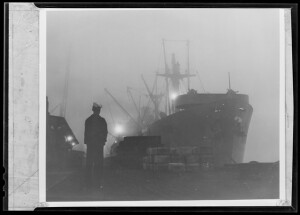 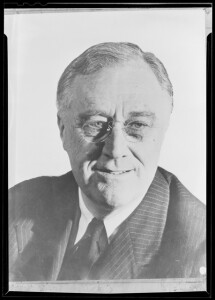 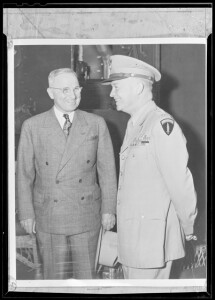 | 1945-1946 | University of Oxford–Photographs.; University of Michigan–Photographs.; Madame Tussaud's–Photographs.; Notre-Dame deReims (Cathedral)–Photographs.; Queen Mary (Turbo steamship : 1936)–Photographs.; West Point (Transport : AP-23)–Photographs.; Madison Square Garden (New York, N.Y.)–Photographs.; Caterpillar Tractor Company–Photographs.; Queen Elizabeth (Troopship : 1940)–Photographs. | Newburgh (N.Y.)–Photographs.; Reims (France)–Photographs.; Thames River (England)–Photographs.; Regensburg (Germany)–Photographs.; Windermere, Lake (England)–Photographs.; London (England)–Photographs.; St. Ives (Cornwall, England)–Photographs.; Liverpool (England)–Photographs.; Lynbrook (N.Y.)–Photographs.; Philippines–Photographs.; Strasbourg (France)–Photographs.; Rouen (France)–Photographs.; Torquay (England)–Photographs.; Hudson River (N.Y. and N.J.). Photographs.; Cleveland (Ohio)–Photographs.; New York (N.Y.)–Photographs.; Canterbury (England)–Photographs.; Jersey City (N.J.)–Photographs.; Moscow (Russia)–Photographs.; Sacramento River (Calif.)–Photographs.; San Francisco (Calif.)–Photographs.; Adirondack Mountains (N.Y.)–Photographs.; Windsor (N.Y.)–Photographs.; Milan (Italy)–Photographs.; Ridgefield (Conn.)–Photographs.; Golden Gate Bridge (San Francisco, Calif.)–Photographs.; Avignon (France)–Photographs.; Danube River–Photographs.; Kremlin (Moscow, Russia)–Photographs.; Bavaria (Germany)–Photographs. | Textile fabrics–Photographs.; Velvet–Photographs.; Dredges–Photographs.; Barges–Photographs.; Clocks and watches–Photographs.; Cotton–Photographs.; Cotton picking–Photographs.; Diamond jewelry–Photographs.; Pearl jewelry–Photographs.; Tankers–Photographs.; Transport planes–Photographs.; Fishers–Photographs.; Boaters (Persons)–Photographs.; Brewing–Photographs.; Breweries–Photographs.; Processions, Religious–England–Photographs.; Dinghies–Photographs.; Parrots–Photographs.; Fishing boats–Photographs.; Railroads–New York (State)–Photographs.; Indigenous peoples–Philippines–Photographs.; Enslaved persons–Photographs.; Wood-engraving–Germany–Photographs.; Wood-engraving–England–Photographs.; Taxidermy–America–Photographs.; Bas-relief–Egypt–Photographs.; Teddy bears–Photographs.; Passenger ships–New York–Photographs.; Horse-drawn omnibuses–Photographs.; Geese–Photographs.; Rugs, Persian–Photographs.; Mausoleums–New York–Photographs.; Cable cars (Streetcars)–San Francisco–Photographs.; Factories–Photographs.; Blue collar workers–Photographs.; Airships–Photographs.; Schooners–Photographs.; Steamboats–Photographs.; Stagecoaches–Photographs. | Contains photographic negatives titled Silhouette Sailor Watching Transport at Night in Dock, President Roosevelt portrait, President Truman & General Eisenhower Talking, Sateen Velvet Fabric closeup, Material or Fabric with Stripe, Large Dredge in a River Dumping into Barge, Lawn at Camp Robinson Crusoe with Trees & Nice Clouds, Girl's Hands on Harp, Girl Wearing Girdle & Bra with Arm Raised to Cover Face, C82 Packet Super Cargo Carrier Plane on Ground, 150 Watt Electric Mazda Light Bulb, River Basin & Shipping on the Danube Near Regensburg, Germany, Oxford University England, View Overlook Lake Windermere, Religious Procession in England, On the Thames Boatman in Rowboat, Porches & Balconies of London Apartment House, Parakeet White in Cage, Madame Tussauds Waxworks London, Fisherman & Boat at Dock at St. Ives, England, 3 British Workmen Figs & Heads, Long View of Liver House Liverpool, England, Closeup of Tower & Clock Above, Power Line TowerAlong Railroad Track, Modern Twin Lamppost on Peninsular Bend in Lynbrook, New York, View of Auto Post Lights Up When Hit by Lights, Man Using Power Lawnmower, Drama & Comedy Masks, Abacus Chinese Swan-Pan, American Opossum & Young on Back & Tail, Cathedral of Rems, France, Stone Cooking Pot & Onions & Frankfurters, Natives Baling Hemp Primitive Method, Albay Province, Philippine Islands, Native Woman Hand Stripping Hemp, Philippine Islands, Old German Woodcut of Ropemaker, Federal Theatre Project Photo of Backstage Showing Curtain Ropes, Old Engraving of Strasburg, France, Cathedral Rouen, France, King of England in Carriage, Audience in Theatre Applauding, Frosted Food Center Store in Lynbrook, New York, Typical British Rural Home, View of Lands End of Torquay, England, Old Central Norte F.C. & C & N Locomotive, Old Locomotive & Tender Side View P.O. Railroad, Old Locomotive Chinese Yueh Han Railroad, View of Hudson River from Plum Point Lawn, Double Highway on Route to Newburgh, New York, Main Street in Newburgh, New York Showing Hotel and Movies, Army & Navy Store Irv. Kaplan Sign, Old Office Building with Spencerian Business College at Newburgh, New York, Union Terminal Tavern & Railroad Station Cleveland, Ohio, On Rushing Locomotive Head On Pulling Train, Line Up Side by Side Head on of 5 Santa Fe Railroad Streamliner, Line up Side by Side Head on of 4 Steam Locomotives at Right, Electric Locomotive Hauling Gondola Car NYRH, Railroad Power Plant Capable of Generating Electricity for City of 10,000 People, Provelick Papers Engraving of Christmas in England, Ancient Egyptian Bas Relief Tablet, Toy Teddy Bear Seated Arms Out, Burling 5600 Locomotive on Turntable, Northern Pacific Railroad Eastbound on Siding for Westbound Train, CB & Q 5400 Diesel Pulling Oil Cars Sheep Horse Canyon, Wyoming, Can Pac Steam Draw Freight Train and Tracking, C & EI Tank Train Enginer Leaning from Cab, 3 N & W Locomotives Drawn Up Together, Twin City Zephyrs CB & Q Along Russ River, Can pac Railroad Freight Passing Under Viaduct, Queen Mary Passing Battery, New York with Troop and Tug, Hand Pulling Fire Alarm, Hedge Clippers Leaning Against Garage Door of New York City, Street Cars of 1903 Horse Drawn, Horse Drawn Carriages Driving in Central Park New York 1904, Gp Railroad & ER Railroad Company New York City Horse Car, Central Park Auto Bus About 1910, Old New York Horse Car Roosevelt Street Ferry Line, Market Scene Lower West Side Circa 1900 New York, Washington Street New York Locomotive & Engine Mat, Horse Car on West Street Traffic & Ship at Dock, Grand Street Ferry Horse Car, East Broadway 1907 Snow Plow & Trolleys in Sun, Congested Trucking Scene Lower East Side New York about 1910, View Over Barge Office & Battery 1915, Easter Sunday 1901 New York 59th Street Plaza at 5th Avenue, Marine Dredge at Work in River, 4 Masted Steel Hulled Schooner at Anchor Full On, Troop Transport West Point Docking with Returning Troops, Queen Mary & 14,000 Returning Troops Passing Battery Skyline, Girl on Rock Looking Over Lakes & Islands of Adirondacks, Liberty Ship Looms Up Through Fog, Finished Car Leaving Chevrolet Plant Inspector Marking OK on Windshield, Engraving of Queen Elizabeth I Portrait, Open Cigarette Case and Closed Leather Case, Line Up of Horse Carts at Horse Show Madison Square Garden, Main Street Newburgh New York Looking to Hudson River, Double Highway Looking Up Near Newburgh, 1 Story Country School House Winsor, New York, Exterior of Hebrew Synagogue, Newburgh, New York, Exterior of Welfare Department Building Newburgh, New York, School Ahead Slow sign, Goose Side View Wings Spread, Goose Side View On Lawn Just Standing, Engraving Entrance to Great Bazaar at Ishapan, Persia from Harper's Magazine, Portion of Persian Rug Circa 1600 AD, Ancient Mural of Egyptian Women & Oil Beauty & Restaurant, View Looking Down on Road from Fairview Mauseoleum, Entrance to Fairview Mausoleum, New york, Canterbury Cathedral, England, Journal Square Jersey Journal Building at Right, Full View of Persian Orial Rug, Mural of Egyptian Heiroglyphics, Croseus on the Funeral Pyre, 2 Couples After the Theatre of 1890 Using a Chafing Dish, Kremlin in Moscow Tower of Ivan the Great Great Bell at Foot, Cathedral Milan, Italy, Engraving of French or Italian Maid With Parasol About to Descend Step, Engraving of Winter Scene Carts of Road River at Right, Fluted Colemns at Persepolis, Ancient Persia, Roman Home Scene Baby on Floor, Egyptian Paintings on Wall, Road Intersection Hudson Boulevard North Bergen, New York, Armour Soap Works in Jersey Swamp, Caterpillar Tractor Company Works Peoria from Air, Industrial Rayon Corp. Plant Plainsville, Ohio from Air, Hands of Draughtsman with Drawing Pantograph, View Down on Hoboken Docks & Fletcher Company Drydocks New Jersey, river Steam Paddle Wheeler on Sacramento River, California, Shooting of Mayor 1910 New York Mayor, Night View of Locomotice Lighting Up track Ahead, Wedding in Church Bride and Groom at Altar, Wedding in Church Couple in Aisle Before Altar, Bridal Couple in Car with Rice about to Drive Away, Old Engraving from British Sports Manual of Staghounds Running & Horses & Riders in Rain, Old New York Engraving Custom House & Wall Street New York Hawk or Falcon Approaching, Old New York engraving Custom House & Wall Street New York with People Promenading, Case Reaper Drawn by Tractor Cutting Grain, Corn Binder Dropping Corn into Wagon, Elderly Man Using Draghting Instrument at Work on Plans, Cotton Gin View Down Room Between Two Rows of Machines, Trust Company of New Jersey Building & Fox State Movie Sign, Overhead Railroad Crossing of Railroad Tracks New Jersey, View Through One Transmission Line Tower Down Line of Them New Jersey Meadows, Little Sharps at Fireworks Factory New Jersey, View Through One Transmission Line Tower Down Line of Them New Jersey Meadows, Ascot Races Egland Grand Stands & Enclosure, Ship Square-Rigger Under Sail in Heavy Sea taken Water over her Deck, Ship Imperator Alexander, View of Rear of Cathedral of Saint John the Divine from Over Park, Mansion & Lawn at Plum Point, New York, Fieldstone Bungalow Near Newburgh, New York, Blue Persian Kittens on Toy Gate, Pennsylvania Railroad Box Car in Front of Stone House, Ripples in Pool at Sunset Dark Shore Outline in Background, Clouds High in the Air from Above, Roaring Rapids in River Little Fork River in Minnesota, Photo of Glass Goblet Marina, Street of Homes in Ridgefield, Connecticut, Men & Women Seated in Hall from Rear Attending 1st Class, Looking Down on Man Seated at Draughting Board Using Universal Draghting Machine, The March Trotter Engraving of Jockey on Trotting Horse, Engraving of Steeple Racer Taking Water Jump, Looking Down on head of Draughtsman at Drawing Board with Universal Draghting Machine, Grandfather's Clock Chinese Decorations from W&J Sloane Company, Old English Sporting Engraving, Old English Engraving two Horses Pulling Cart, Old English Engraving Hunter & Rider Taking Fence, Frigidaire Operating Metal Cooling Box, Workman Pouring Melted Aluminum in Mold, Workman Pushing Handtruck with Castings, Modern Factory Building with Cars Before It, Unloading Glass Sand from Freight Car, 2 Men in Office in Factory at Blue Print Machines, 3 Vertical Transformers in a Factory, Man Alongside Gas-Fired Oven in Factory, Hospital Bed in a Room at Factory, Dynamo & Electric Motor on Concrete Base, Men at Work in Factory on Vacuum Cleaners, King John Signing the Magna Carta engraving, Pocahontas Saving Captain John Smith from Indians engraving, Henry II of France & Duke Montgomery of Scotland in Tournament engraving, Knights on Horses in Armour Tilting Contest engraving, Portrait of Christopher Columbus, Portrait of Catherine de Medici in COurt Dress, Portrait of Marco Polo, Portrait of King Henry VIII of England, Portrait of Queen Isabella of Spain, Portrait of John Gutenberg, 2 Knights Crusaders engraving, Signing of the Mayflower Compact engraving, Place d'Armes New Orleans, Louisiana, Hands Holding Metal Platter of Steak & Veggies, Main Financial Street Memphis, Tennessee, Interior of Modern Kitchen Showing Stove & Sink & Breakfast Nook Through Door, Lumber Raft on Klamath Lake, Oregon, Molde Norway Church Steeple Burning After Hit by German Bomb, Deck of Queen Elizabeth Crowded with Returning Soldiers, Hands of Girl Holding Deck of Cards, General View of a Banquet, Cleaning Master Rods with Oil Spray Gun in Spray Booth, Electrician in Plant with Cart & Gear, Electrical Maintenance Crew Using Greenlee Pipe Bender, Cleaning machine for Removing Oil & Dirt from Mechanical Parts in Airplane Motor Plant, Cleaning Man Using Brush to Sweep Floor in Factory, Mill Wright and Crew Moving Drill Press, Laundry Machine for Cleaning All Sizes of Mechanical Parts in Airplane Motor Plant, Wilbur & Orville Wright with Early Model Baby Wright Racer Plane, Drying Paint on Auto Bodies in Infra-red Tunnel, San Francisco Oakland Bay Bridge at Sundown, Cable Cars Passing Each other on Hill in Sanfransisco Direction of Chinatown & Bar Bridge, Golden Gate Bridge San Fransisco, Closeup of Sisal Plant Agave Sisalana, A Sisal Plantation Rows of Plants, 16th Century Venetian Art brocade Tapestry, Currier & Ives Engraving of Clipper Ship Dreadnaught, American Clipper Great Republic from Engraving in Illustrated London News, Early Photo of Whaler, Engraving of California & Oregon Stage Company Stage Coach, Engraving of Early American Stage Coach Mansion on Hill in Background 4 Horses, Early Photo of Stagecoach 3 Horses on Road in West, Wells Fargo Stage Coach on Road, US Troops & Train at Avignon, France, Bow View of Transport at Sea with US CT, Parthenon-like Building in Bavaria, Arc du Carrousel Paris, Statue of Jeanne d'Arc Reims, France, Flying Buttress on Notre Dame Cathedral Paris, Assortment of Fancy Glass Liquor Bottles, Pioner Fishing Seiner Underway, Quick Freeze Food Lockers Counter and Butchers, All Over Black Pattern of Snowflake Crystals, Bok Tower Lake Whales, Florida, Aurora Borealis Diagonally Across Sky Lower Left to Upper Right, natives Cutting Sisal Plants for Hemp, USS Midway Carrier Passing Troopship at Sea, Old Print of Coaching Scene in England, Old Engraving of Aurora Borealis, and Booth Mills Lowell, Massachusetts Looms in Cotton Mill. | P0002.001/50-149 |
Created 2026 by Don Barker, CBMM volunteer, for the Chesapeake Shipbuilding Project. shipbuilding@sailingworkboats.es